Sunday, 29 September 2013

Rise of the Guerrilla Writer


Most people happily believe that they have a novel in them, but getting a publishing deal has always been the impossible dream; even success stories generally include multiple early rejections, time-consuming back-and-forth and then a tiny trickle of royalties if you're lucky enough to earn out your advance. In short, a tough life.

Amazon has led the way in changing the fortunes of those who are hoping to hit the bestselller list. With the advent of the Kindle they introduced direct publishing back in 2007. The payments have remained the same since 2009: any writer who uploads a book earns 70% of the takings – a generous slice of cash considering that you can't get a bigger platform for your offerings.

E-books have been overtaking paperbacks for several years now, and Barnes & Noble, Sony, Apple and Kobo all have their own e-readers AND offer writers the opportunity to self-publish. If your readers don't own a kindle, they can still find a format that suits them (hell, they could even download the kindle for PC if they were really keen).

This new freedom has revolutionised the publishing business. It's a slow process, but it seems the "big six"  are losing their grip and independent publishing is the way to go. Just as the music business was transformed by Myspace and Youtube, artists and writers no longer have to wait around for someone in power to notice them or hand them the keys to success. These days they can simply release their work online, publicise it on twitter / tumblr / facebook etc and reap all the financial benefits themselves.

So, the good news is: anyone can publish a book if they want to. The bad news is, anyone can publish a book if they want to. "Indie" authors hate it if you mention this, but there is a huge amount of crap out there. Scan the "free" and 99p range of books at Amazon and among the old classics you'll find hand-drawn covers, blurbs riddled with typos and the proud claim "this was written when the writer was only sixteen years old." (I think it's best if we all just burn those old notebooks, isn't it?)

Of course, on Kindle nobody knows you're a dog.

The flood of books which wouldn't even have made it as far as the slush pile is astonishing. (Some of them are even selling quite well.) But let's face it, amid all the 5-star reviews from the writers' friends and family, there are an awful lot of notes about misspellings and the staggering need for an editor.

However, there's a dedicated group of authors who take their professionalism very seriously and are working hard to get away from the "all self-published books are crap" stigma. They spend money on editors and copy editors and employ professionals to design their covers. Some create their own publishing companies to avoid the giveaway "Published by Amazon" moniker. (There are some unscrupulous establishments which offer to do the quick work of formatting and uploading the book, in exchange for a large percentage of the royalties. This dubious deal only works for those who would rather have books released under an umbrella name than put up with the shame of going it alone. Talk about vanity publishing...)

Bestsellers such as The Shack and 50 Shades of Grey* started life as indie novels (with the latter perhaps not really helping to erase the expectation of terrible writing) and even Jackie Collins is doing it. So with all these new developments, I wonder why on earth anyone would still choose to be traditionally published?
  1. I want the validation of having someone in the biz tell me that I'm good enough.
  2. I want professional help with the editing and cover design.
  3. I want to sell paperbacks because I don't think much of these new-fangled e-books.
  4. I want to do fancy book signings and have long boozy lunches with publishers.
  5. I want to be eligible for awards. 
  6. I don't want to have to do all the marketing myself.
  7. I want to see my books on the shelves in book shops.
To which I would answer:
  1. You don't need a publishing gatekeeper – sell directly to readers and they'll let you know that you're "good enough" by buying your book and leaving you nice reviews. Besides, think of all those stories about classic novels which were turned down a million times prior to publication. Publishers are guessing as much as the next man; if they weren't, every book they signed would be a bestseller.
  2. You can get professional help with editing, cover design and whatever else you desire – you just hire freelancers. (And help out a small business too. How cool is that?) You might end up spending cash on editing even if you sign with an agent –- apparently they often recommend a "book doctor" they know for polishing the manuscript before they take it to publishers.
  3. You CAN sell paperbacks. Amazon has a program called Createspace and there are a few other indie printers springing up.
  4. You can organise your own book signings. The same goes for publicity interviews with book bloggers, tours of cities and anything else a publisher can organise for you (but probably won't). Many indie writers do all of these. (The boozy lunches will probably have to be solo, though. At least you'll be following a grand tradition of literary greats.)
  5. Ah, here's where things get tricky. There has been some snobbery about self-published books although they are now recognised by the NY times bestseller list (and yes, some of them have made it). This may or may not improve but there are also steps you could take to make your "independent publishing business" look more legit. 
  6. Tough luck, because you're probably going to have to do 99% of it even if you do get a traditional publishing deal. Agents now look out for writers with a strong online presence – if you have 5,000 twitter followers awaiting your novel because they know it's going to be right up their street, you're in a stronger position than someone who doesn't know how to work Facebook. It may not make or break your book, but if there are only so many deals to be handed out that year, why wouldn't the publishers go with someone who is a sure-fire money maker, rather than risking it on the total unknown? Duh!
  7. What's a bookshop?
Ha ha. I jest of course. Except it's not really funny. I may not be entirely responsible for the demise of the bookshop, but I'm a pretty good example of why they've failed, as I haven't bought a book in one since 2002, when I discovered Amazon. (To be fair, it's only huge chain stores like Borders that I have forced closure upon, because my hometown doesn't really do "cute independent" shops.) I do still buy from second hand bookshops, obviously, and I love book swapping sites like greenmetropolis and readitswapit.

Here's a shameless plug for some of my artwork depicting my love of the written word:
https://www.etsy.com/uk/shop/Beckalicious

The trouble is, Amazon is just better. (And this is why it's the biggest freaking bookshop in the world). Not only are books (and everything else) likely to be at their cheapest at Amazon, but it's so much more fun (and informative) to browse when you know that you're accessing a list of pretty much all the books there are, instead of the tiny fraction represented by Waterstones. I can find a book I'm interested in, read reviews about it, and discover what else was bought by fans of it (this has been an invaluable tool, and I hereby thank every Amazon reviewer who has led me to new and fantastic books and music).

The only way that bookshops had the internet beaten was the ability to flick through the pages and get an idea of the writer's voice – but now that Amazon boasts a "look inside" feature, they've got the market cornered. Bookshops can't compete with the ease of online window-shopping, so even though Amazon are a big giant evil corporation which is taking over the world, they are very clever at what they do. And thanks to them, writers have more publishing freedom than past generations could ever dream of.

If making your self-published book available worldwide through the miracle of the internet isn't enough, you can actually get those paperbacks you printed into bookstores. Pick the marginally more expensive option of "expanded distribution" at Createspace (or use the slightly less writer-friendly printers at Lightning Source) and you can walk into a bookshop and order your book. You can even offer it to libraries.

 
Don't you want to be the reason for this kind of happiness?

Waterstones themselves actually accept submissions from independent publishers, so get yourself a website and a PO Box and you're sorted! There's no guarantee that they'll choose to stock your book, but there's no guarantee it will happen for a first time traditionally-published writer either – not while the shelves are packed with diet guides and celebrity autobiographies.

What else can a big publisher do that you can't? Well, they do have the power to publicise your book with far greater reach than you could do yourself. However, that doesn't mean that they WILL. How many books do you think get published per year? Hundreds of thousands, right? And how many do you see reviewed in newspapers, touted in posters on the tube or given pride of place in bookshops? A mere handful. (And at least half of those will be established authors like Stephen King and J.K. Rowling, who would only need to upload a book to kindle for the news of the new release to whizz around the world within minutes.) 

And the money? There is no publisher on earth who could offer you a 70% share of the profits. Advances for first time writers tend to be fairly modest, and it's decidedly short-sighted to get all excited about a lump sum when you could earn far more over thirty years (and beyond) by opting for a higher percentage of cash. Also, some aspiring authors have this odd quirk where they see the advance as a wonderful, magical gift from the gods. Let's make one thing clear: an advance is not *extra* money. It's literally an advance of the money that you're expected to make. So let's say that your publishers are guessing they'll make £100,000 out of your novel. Your contract is 12% of those profits, so your advance is £12,000. If you end up making more than your publishers expected you to, that's when you'll start getting those dribs and drabs of royalty cheques. Again, not extra money – still part of your 12% share of the profits.

While you may think that you don't want to be bothered with the details of editing and cover design, you might change your tune when it becomes apparent that you have absolutely NO SAY in them. There are horror stories about agents or publishers who ask for extensive rewrites and then end up passing on the finished product. Writers such as Isobel Losada (who has been vocal about her frustration with traditional publishing) have openly said that they hate the covers chosen for their books. (Try googling "writer hates book cover" for entertainingly horrific stories of Kafka-esque conversations with editors).


Another advantage of self-publishing is that you can make changes instantaneously on Kindle editions, and Print on demand (or POD) arrangements mean that there will be no print runs of 50,000 books before finding a typo. Although indie writers get a bad rap, mistakes occur in books which have passed through the hands of several professional editors / agents / publishers. Who could forget Susan Anderson's infamous love scene in which her hero "shitted on the ground"?

Many disillusioned traditionally published writers tell war stories on Amazon's messageboards for writers (a fantastic resource, by the way). Evidently getting an agent (the holy grail for the aspiring author) may be only the beginning of the battle.

As one contributor puts it; "Here's another thing that I've learned over the years and my most recent agent confirmed – each agent has a limited number of contacts with editors. They might know 10-15 editors that they have lunch with, and these are the editors they have a legitimate shot of selling books to. If they send out a submission to an editor they don't have a relationship with, it's very low probability that the book will be taken seriously."

And worse; "Agents have super short attention spans.  If your book gets turned down 3 or 4 times, they lose interest and spend their time on the next hot chick on the block. If another agent has tried and failed, your book's not a virgin so you can basically fuggedaboutit even if you get another agent."

(N.B. Obviously, I have no guarantee that a random person on a forum is a reliable source. But you have to admit, it sounds true.)

Another member described a depressingly pessimistic "best case scenario" for getting a publishing deal:

"Immediately after reading my post, you get an email from an agent you queried six months ago. She loves the sample chapters you sent her and wants to read the whole thing.

One month later (October 2013), she writes you, saying she loved your book and wants you as a client. You sign.

Six months later (April 2014), she tells you she has a publisher interested in your book. Negotiations begin.

Three months later (July 2014), negotiations are complete. You sign with the publisher for a £5,000 advance (although it's much more likely to be £2,500, but this is the best case scenario). You don't know it at the time, but this is all the money you will ever see from this book. Your book enters the publishing world's deep freeze.

Eighteen months later (January 2016), following cover design, edits, and pricing, which you have no control over and are told by your 25-year-old editor to take it or leave it, your book appears in the stores.

Six weeks later (March 2016), your book is pulled for lack of sales, during which time the publisher has done nothing whatsoever to promote you or your book, telling you they "don't have the staff like they used to" to do all the stuff you say you don't want to do. They advise you instead to "set up a few signings in your area" to boost your profile, at your own expense, of course. Meanwhile, after your book is pulled, all remaining copies are ground up into pulp.

And that's the best case scenario. It would likely take longer. Oh and the publisher now owns the rights to your book. Good luck getting them back." 

As Cheever could tell you, there's a reason why writers drink.

Of course, there are the exceptional cases; Twilight was Stephenie Meyer's debut but it bought her a $750,000 three-book deal. (On the other hand, J.K. Rowling only got £2,500 as an advance for the first Harry Potter story. Luckily she went on to make a few bob anyway.) Publishing via Kindle is a similar crapshoot; Amanda Hocking famously made $2 million in her first year of releasing vampire fiction; but half of the self-published writers earn only $500. Yikes. (To put this in perspective, check out this traditionally published author's glee at earning out her advance – I calculated that she made less than $1.25 per book sale.)

Even the established authors getting nice lump sums claim the numbers are not all they seem; Barry Eisler famously turned down half a million dollars in favour of publishing independently and explained his decision thus:"My tendency has been to focus too much on that big, seductive number. But to understand what the number really represents, you have to break it down. Start by taking out your agent's commission: your $500,000 is now $425,000. Then divide that $425,000 over the anticipated life of the contract, which is three years (execution, first hardback publication, second hardback publication, second paperback publication). That's about $142,000 a year.  This is a more realistic way of looking at that $500,000."

There are plenty of articles and blogs by traditionally-published writers who have turned to self-publishing in order to regain control over their books and the income they generate: James Altucher tells of the sneaky way that publishers claim credit for publicity you've created yourself, and Michael A. Stackpole likens trad-published writers to ignorant slaves (vs the "Spartacus" indie who has seen the benefits of jumping ship). Alisa Valdes-Rodriguez points out that when it comes to giving the readers what they want, the writer's instincts are far better than the "but we've never tried that before" publisher's. (And no, I've never heard of any of these authors either, yet they're selling enough books on Kindle to make a living. Interesting....)

There's also a particularly terrifying description of publishing loopholes which are akin to selling your soul to the devil; if you do want to pursue a traditional deal please get a great lawyer first! It seems that writers who are determined to concentrate on the art and not worry their pretty little heads about the business side of selling books are in for a rude awakening: as it turns out, agents are not the warm-hearted mother hens we've been led to believe! One might even say they're in it for the fast buck (a quick sell to any publisher) because they get 15% of every deal they close and they have plenty more writers standing in line behind you. Who'da thunk it? (And don't assume that your publisher won't try to lay claim to the books you release by yourself, either.)

So what advantages do agents and publishers really offer? Basically, film rights and foreign rights. That's it. Oh, and respectability.


Really, who cares about who published a book? If it's any good, readers will like it. Life's too short to put up with glacier-speed progress, contracts in which the person who does the least amount of work makes the most money, and being told what to do by people who have even less of a clue than you do.

Of course, you might sign with the best agent in the world, but it's unlikely that a first time writer will get anything more than a push out the door and a flurry of sales before the publishers have to move on to their next project – they simply can't put a huge amount of energy into publicising every book when they have hundreds more in the system.

From the number of  indie writers who are offered deals, it seems that publishers now use Amazon as the slush pile and cherry-pick the books which are guaranteed sellers. But if you self-publish and sell lots of books, why would you want to randomly divide up the pie and hand someone else money for what you've created?

Self-publishing isn't for everyone; you'll need a flair for business and marketing as well as the ability to actually write good books (not to mention nerves of steel). But hasn't that always been the case for anyone publishing a book? The worst case scenario is that you upload your book and it never sells a single copy. The worst case in traditional publishing is that you tout it to agents for years and years without ever getting a deal. The end result (nobody reading your book) is the same, but the first option sounds like a lot less soul-destroying hassle to me. 

Viva la revolution!

ETA: Whoops, I fell for the media hype. 50 Shades of Grey was in fact NOT self-published. Truth really is stranger than fiction...

Sunday, 15 September 2013

The problem is not the teenage girls. The problem is your attitude about the teenage girls. Do you understand?


So, the latest blog to go viral is a missive from Kimberly Hall, a director of women’s ministry in Texas. She's written a helpful guide for teenage girls who have been taking "selfies" in their bedrooms: RUN to take down those doozies! The Halls won't be friends with you if you don't!

She begins by explaining "Last night, as we sometimes do, our family sat around the dining-room table and looked through the summer’s social media photos." (Wow. That doesn't sound creepy at all. We all stalk people we know on Facebook, but we don't TELL them about it. It's like, the first rule of the internet.) She then points out that an awful lot of teenage girls are posting pics of themselves in their "skimpy pj’s" (sic) and worse, they're adopting an unnatural "red carpet pose" with "extra-arched back, and the sultry pout".

Well, yes. Teenage (and older) girls are still labouring under the bizarre belief that it looks super-attractive to "duckface" in a series of self-obsessed pictures (occasionally with the added bonus of a toilet in the background). It's what they do. None of us like it, and we all kind of wish that these girls could really see what they look like and how much they're going to regret the shots in the future. (Except some of the girls doing it are 35, so I think the ship might have sailed on the "older and wiser" theory.) They have no idea how contrived those "spontaneous" shots look: 


However, we all have autonomy when it comes to the images we choose to represent us online: if girls want to look trashy rather than classy, it's up to them. What irks me about the blog (apart from the somewhat arrogant view that being blocked by the Hall family will be a "big bummer" for these unlucky girls) is the totally unchristian sentiment behind it. Yep, you heard me right. UNCHRISTIAN.

Why? Well, Hall claims "we are hoping to raise men with a strong moral compass, and men of integrity don’t linger over pictures of scantily clad high-school girls." (Except when they're reviewing them for judgement purposes, obviously).

You know what else men of integrity do? They don't say "Hey, YOU need to change your behaviour so that I won't have any problems with it." Have a browse through the teachings of Jesus and you'll find an astonishing lack of instruction about how to control other people so they stop tempting you to sin. 

Matthew 5:27-28: "You have heard the commandment that says, ‘You must not commit adultery.’ But I say, anyone who even looks at a woman with lust has already committed adultery with her in his heart."

Wait, where's the part where he says it was her fault anyway for flaunting herself in front of you?

Yeah, remember the way Jesus treated prostitutes and adulterous women? 
He was really into slut-shaming! Oh...

Imagine if we all applied the sex rules to any other aspect of life. "It wasn't my fault I stole those cakes! The baker shouldn't have made them look so delicious and then displayed them in the window if he didn't expect people to just take them!"

If we're going to live with Christian values, we have no choice but to take responsibility for ourselves. The Hall boys are going to be seeing scantily-clad women everywhere from bars to billboards; the onus is on them to control their "impure" urges. As Al Franken said, “It's easier to put on slippers than to carpet the whole world.” 

Matthew 7: 1-4: “Do not judge others, and you will not be judged. For you will be treated as you treat others. The standard you use in judging is the standard by which you will be judged. And why worry about a speck in your friend’s eye when you have a log in your own? How can you think of saying to your friend, ‘Let me help you get rid of that speck in your eye,’ when you can’t see past the log in your own eye? 

Well, yes. It probably wasn't the best idea for Mrs Hall to accompany her entire blog with lots of topless pictures of her sons and to describe how she fell for her husband when she spotted him half-naked. Unfortunately she took her own advice and deleted that post (which had pictures!) so we can't point and laugh at it anymore.

One commenter says "I see you have had some bashing here for the pics of your sons in swim trunks. I think we need to consider the different circumstances. They are playing at the beach. The poses are not provocative (arched back, pouty lips……we have all seen those teen girls and the pose I am refering to)... If the boys were posed in speedos on their beds with a come hither pouty bad boy look – then there would be something to throw rocks over"

Um yeah, you've kind of missed the point here haven't you? For boys, showing off their muscles IS the provocative pose. It may not be super-sexy to be snapped frolicking on the beach with your brothers when it's your mum taking the pictures, but they clearly revel in the bare-skinned freedom that only men can enjoy. After all, if they made the same kind of "sexy" poses girls do, they'd look stupid:

 
But this picture is fine, of course. They're totally not posing in a way that they hope will be sexually appealing:
 
Luckily, no teenage girls will ever see these pictures on the
 internet and be tempted to think lustful thoughts.

These poor kids are subject to their parents' mixed messages: as well as having their own poses recorded for posterity in a public blog, they have to deal with the madonna / whore complex that is apparently de rigueur in Texan churches this summer. As Mrs Hall puts it, "Did you know that once a male sees you in a state of undress, he can’t quickly un-see it?  You don’t want our boys to only think of you only in this sexual way, do you?" Yep, once he's seen you in skimpy attire, he can never go back to seeing you as the intelligent, thoughtful, well-rounded character that you were when you were covered up! Bad luck, Hall kids' future wives...

The Given Breath blog has done teenage girls a huge favour – if nothing else, they've learned that keeping your online profile set to "private" means nothing – you still don't know who might have access to your pictures. The second lesson is that there will be men out there who do see you as nothing more than an empty shell of sexuality if you so much as take one picture in your pyjamas; they have learned to see you this way because it's what their momma taught them.

Sunday, 25 August 2013

The Benefits of Speaking Up...

Honesty is allegedly "the best policy", although we all ignore this rule when it comes to receiving hideous gifts, viewing children's artwork and responding to the boss's proposals. (One day I'm going to write a blog about all the stupid things I've heard while working in the advertising business. It will be a long and cathartic post.)
If only one person at Adidas had piped up with "I don't think slavery IS very chic, actually..."
The importance of being upfront came to mind when reading the story of 20-year-olds Michaella McCollum and Melissa Reid, from Northern Ireland and Scotland respectively. The girls had both found bar work in Ibiza before apparently falling in with the wrong crowd and getting caught trying to smuggle cocaine out of Peru. 

They now face up to 15 years in jail if found guilty, with their only defence being the claim that they were coerced into being drug mules. Held at gunpoint, their distant families threatened, and told they would be watched at all times; the girls insist they had no choice in the matter. 

Whether we say "pull the other one, love!" or accept the story, it brings up the point that shouting your predicament from the rooftops is nearly always the way to go. Alberto Arian Barilla of the Ibiza police force pointed out what we were all thinking: "The first thing you do is go to the passport control and say 'listen, this is what is happening to me'. The policeman will react." (For the record, the girls claimed that their "kidnappers" had told them they had people working at the airport too – so whistle-blowing seemed too risky.)

It may be hard to believe that these girls could truly fear that every single airport worker was in on the plot, but it's not entirely unrealistic that someone could make the mistake of keeping schtum – it's been shown on the big screen many times. The trouble with movies is that they sort of need the protagonists to make stupid decisions, because films wouldn't last longer than twenty minutes if everyone just called the police at the first sign of trouble. Maybe I'm getting jaded in my old age, because I used to be able to simply put my "Suspension of Disbelief" hat on and enjoy a plot-hole-ridden caper, but now it's getting on my nerves so much that it's ruining my enjoyment of perfectly good films. 


Take Red Eye for instance. Great cast – Rachel McAdams being adorable and feisty and Cillian Murphy flashing the piercing blue eyes which have made him Hollywood's go-to guy when casting sexy young villains. (Where the hell was he when they were auditioning for Hannibal Rising?) Great director (Wes Craven) and a script which allowed for decent characterisation as well as plenty of twists. I almost loved it, but got too frustrated with all the gaping logic holes. For instance, when terrorist Cillian explains to Rachel that he's got henchman waiting to kill her dad if she won't go along with his assassination plot, he's apparently relying on all the surrounding passengers being completely deaf. Ok, so there's no other way to make a "hostage on a plane" film; we'll let that one slide. (But surely someone would have noticed him punching her in the face?)

This wasn't even the biggest problem. Seeing as there was a hitman waiting for instructions to target Rachel's dad, she could have alerted a flight attendant to the fact that (gunless) Cillian was a bad guy, and asked them to contact the FBI to get protection to her father ASAP.  But that would have been way too easy and there wouldn't have been a big chase scene and stuff, so whatevs. 

I got similarly frustrated with Taken 2 when Liam Neeson's poor teenage daughter was about to get kidnapped again. (As a side note, I don't know what it is about the Taken movies, but I find Liam Neeson really wooden in them. What's up with that?) In the first movie his advice was ok – she didn't have any means of evading the traffickers (assuming she couldn't get to a fire escape) so hiding under a bed was her only option. But in this sequel, her "expert" CIA dad tells her that she should go and hide in the hotel room. Um, no dad, I think I'll just head for a slightly busier place than that, seeing as it's the first place the kidnapers will try and if they do catch me there will be no-one to stop them. How about if I go to the town square and call your colleagues from there, yeah? 

At least make it hard for them to get you without 
embarrassing themselves in public.

All sense of reality slides out of the hotel window when he calls her mere moments after the crooks  have gone – what great timing, huh? Could have been tricky if he'd been any faster at dialling... 

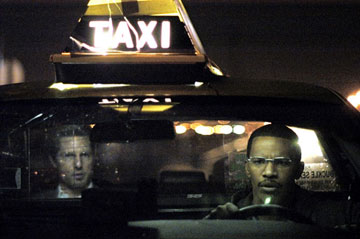
The third movie in my "Nonsensical Decisions" hall of shame is Collateral. (Yes, I'm catching up with lots of movies I've never got round to seeing, I'm bad at going to the cinema). When Jamie Foxx realises that Tom Cruise is a hitman, he makes no efforts to escape (until the worst possible moment, but I won't spoil it for you). While they're trundling along in LA traffic, he could easily have made a sudden bolt out of the car and run for it. Tom wasn't constantly holding a gun to his head, and if he had taken a pot shot at the rapidly retreating Mr Foxx, he's unlikely to have hit him. What's more, it wouldn't be in his best interests to pursue; he'd have just quietly got into another car, safe in the knowledge that the police can't exactly stop and search all the yellow cabs. (Of course, the fact that he chose to take a taxi in the first place is a huge plot hole but we'll pretend we didn't notice it, shall we?) 
 
I'll just wait until you know something about my personal life and can 
threaten my family before I attempt to defy you. That seems to be the best plan.

One movie I have always loved is Ransom, with Mel Gibson and Rene Russo as the parents of an abducted child. When he realises that paying off the kidnappers won't make them return his son, Mel does what he does best and goes batpoo crazy, taking control of the situation by making the ransom a reward for anyone who will turn them in. Striking back at villains is always a winner in my book, even if we're far more likely to come across them when they're trying to hack into our bank accounts or computers...

We're all familiar with the "You've inherited money from a relative you've never heard of in Nigeria" emails, but there is a particularly nasty credit card scam which keeps cropping up and is convincing enough to fool many who considered themselves savvy. It's detailed here but in a nutshell, the con artists convince their victims that their cards have been compromised, then alleviate suspicions by telling their victims to "Call 999 and you can check my identity." 

Most of us would be suspicious if we were told to use an emergency number in this way, but top-notch persuasion techniques assure the victim that the "police officer" who phoned them is kosher. This bluff is dependent on landlines not disconnecting when the original caller stays on the line; using a separate cell phone would solve the problem, but elderly people who might not have mobiles (and may be generally less savvy to scammers) are often targeted. (Seriously, how do these criminals sleep at night?)

So if this happens to me (let's pretend for a moment that I occasionally pick up my landline) my plan is to alert the coppers via mobile (so they can tail the courier back to scumbag headquarters) and then assemble my "credit cards" for collection in a nice jiffy envelope full of dog poop. (Except that I don't have a dog, so I would have to, er... improvise.) The thought of the crooks' disappointed and disgusted faces would make it all worthwhile.

The moment they used the letter-opener...

There must be a special place in hell for con artists who zero in on sweet little old people with rosy cheeks and knitted cardigans, and this story shows just how vile scammers can be. 86-year-old Frances Brown was the target of a similar trick to the phone call above, but she was actually persuaded to go into the bank to  withdraw cash. It gets worse: 

"Barclays cashiers were suspicious why a widow who had never been overdrawn before wanted to take out so much money and asked who was calling her. But the conman had told Mrs Brown not to tell the bank staff why she needed the cash, stressing that the bank was itself under surveillance. So Mrs Brown told staff she needed the cash to pay for a funeral, and they reluctantly allowed her to take the money."

And this is why you should always shout it from the rooftops if you're in trouble. Not everyone in the bank could be in on it, could they? It's easy for us to call victims of these tricks "gullible" but when someone calls you with the news that your account is being drained, you can see how panic mode could set in. Let's save our vitriol for the people who deserve it: the soon-to-be-receivers of our little poop packages. Come on, we can make this happen!

Tuesday, 13 August 2013

Let's Have Some Happy News!

Reading the news is always so depressing... recently we've seen stories on:
  • The old lady who left the government £520,000 to spend "as they see fit". (Was she CRAZY?) David and Nick called it a "party donation", split it between them, and were all set to spend it on champagne and cigars (probably). It was only when publicly chastised by Labour (and even Conservative) MPs that they handed it over so it could be spent on hospitals and schools and other such frivolities.
  • Oprah Winfrey getting the Pretty Woman treatment in a Swiss boutique. (Big mistake. Big. Huge.) So was the shop assistant racist or just rude? Either way it doesn't fill my heart with gladness. 
  • The judge who gave a paedophile a lenient sentence because the 13-year-old girl involved had been a "sexual predator". Is the whole justice system a gigantic paedophile ring? I ask because surely only someone who was a pervert could possibly think that a child was responsible for an adult's sexual crimes? Isn't that why we have statutory rape laws? 
"I am going to tell you something very strange: it was she who seduced me." Yeah, right. 

But things aren't all bad; when they're not trying to make adults have sex with them (!?) kids are actually doing some really awesome stuff.

Firstly there's Malala Yousafzai, who has been nominated for the Nobel Peace Prize after becoming a feminist icon in her teens. Last year she survived an assassination attempt from the Taliban, who got the heebie jeebies at the thought of a 15-year-old campaigning for girls' education. (This reminds me of Eileen Colwell's famous quote on Enid Blyton books: “What hope has a band of desperate men against four children?”) In the 21st century, who knew that such big bad men could be terrified at the idea of females being able to read and write?

Politically active kids isn't a new thing; back in 1992 Severn Suzuki addressed the UN regarding environmental issues: 


Actually, this one's a bit over the top for me, what with the mournful music and the "I know I'm just a child so aren't I precious for making a speech" feel of the video. Still, kudos to her for creating an eco-action group – at about the same time, I was going around the house turning off light switches and making draught excluders out of a pair of tights and some screwed up newspaper in my own efforts to be green. Today, 33-year old Severn Cullis-Suzuki is still known as an environmental activist and campaigner. 

More recently, this Egyptian kid went viral – nobody seems to know his name, but I'm pretty sure he has a bright future in politics. Call me a cynic, but I wonder if the interviewer was expecting such a young boy to have only vague, flimsy reasons for being at a protest (you know, the sort of answers we get when they ask some trustafarians in this country).


How about we get rid of newsreaders and get kids to explain everything instead? 11-year-old Yemeni girl Nada Al-Ahdal tackles the subject of forced marriages for children with eloquent self-possession:


They might be dealing with depressing subjects, but the fact that these children are so smart, articulate and vocal gives me hope. In the age of the internet, they can be heard in a way that would have been impossible otherwise. In fact, the internet  has become our "normal" so quickly that we've come to take it for granted: you only have to take a peep at whitewhine.com to see just how insanely privileged we are (and how entitled we've become because of it).

Seriously, how can anyone who has access to the internet ever consider themselves lacking in anything? Much as I hate to sound like a grandma, when I was a kid and I wanted to watch a film I had to go down to the video shop or wait for said film to come on the telly (so I could stealthily record it onto a VHS tape). If I wanted to look something up I had to find an encyclopedia (which was probably out of date). If I wanted to see a music video I had to wait for The Chart Show on a Saturday morning. When you're older than the internet it gives you a certain perspective on life, and it kind of scares me that stories of my youth will now sound as archaic as my parents' tales of playing 45s on the record player and using the cine-camera to make home movies. (Actually, we still used this when I was a kid; the smell of burning dust and the whirr of a projector takes me back to my childhood "Film nights" when we turned off all the lights and made popcorn and watched the silent movies. And yes, I realise this makes me sound ANCIENT.)

So let's just remind ourselves that everything in the world isn't miserable and hopeless, and there are some kids who have more to offer the world than atrocious spelling and the constant repetition of the word "legit". I leave you with the happiest news of all: there are sheep like this and there are people who record them and put the results on the internet for all to enjoy:


Wednesday, 31 July 2013

There are no blurred lines, Mr Thicke. No still means No....


Now that new parodies are popping up every day, I can't ignore the notorious video for Robin Thicke's Blurred Lines any longer. If you've been living under a rock and haven't seen it yet, check it out. You can also watch the unrated version, which is pretty much the same except that the women are topless. It also uses balloons to completely spell out such witticisms as "Robin Thicke has a big dick".

The first time I heard the track, I couldn't help bopping along, as it's undeniably catchy. The constant repetition of  "you know you want it, but you're a good girl," made me roll my eyes, but at least it's kind of true to life. It's incredible how many guys will think that some sort of prudish self-denial is the reason you're SHOWING NO INTEREST IN THEM WHATSOEVER. (And then if you manage to convince them you really do know your own mind and you honestly don't fancy them, they assume you're a lesbian. Talk about ego.)

Along with Robin Thicke, the video features Pharrell Williams and rapper T.I. (aka Clifford Joseph Harris Jr.) basically standing around while vacant-eyed, pouting models prance before them in very few clothes. As the video has attracted the wrath of feminists, Robin Thicke has spoken out to defend it, saying “We pretty much wanted to take all the taboos of what you’re not supposed to do – bestiality, you know, injecting a girl in her bum with a five-foot syringe –I just wanted to break every rule of things you’re not supposed to do and make people realise how silly some of these rules are.”

Yes, those silly rules! Defying them makes you a super-duper groundbreaker. (Actually, I'm not sure where he got the idea that there is bestiality in the video. One of the girls is holding a lamb at one point, and there is a large stuffed dog which one of them sits on. I guess Robin thinks that when children ride on carousel horses, they are also somehow having sex with them?)

Just a note, Robin: only a total amateur would actually point to his eye 
when singing the line "maybe I'm going blind."

He warmed to his theme, explaining “We tried to do everything that was taboo... everything that is completely derogatory towards women. Because all three of us are happily married with children, we were like, “We’re the perfect guys to make fun of this.”

Hey, I've never shot anyone in the head! That means I'd be the perfect person to do it as a joke! 

It's always hard to gauge someone's tone in print, and I've certainly seen some interviews in which a sardonic pop star makes a joke and the wide eyed 12-year-old magazine editor writes a big headline believing they were being serious. So I think we can safely assume it was a "joke" when Robin said, "People say, “Hey, do you think this is degrading to women?” I’m like, “Of course it is. What a pleasure it is to degrade a woman. I’ve never gotten to do that before. I’ve always respected women.”
Courtesy of PerezHilton.com

And what of the lyrics? The "I know you want it" line is what's got them into trouble with the anti-rape brigade (which is hopefully everyone in the world); it's possible that the song has created such a furore not because it's the worst offender in the "misogynistic lyrics" game, but because it struck a chord with every woman who has ever been chatted up in a nightclub. Or yelled at from a white van. Or groped in the street. You get the picture. (And if you don't, check out everydaysexism.com.) And as Grooves on the Radio points out, "Threatening to tear someone’s ass in two is a lot less sexy than Clifford thinks it is." 

There is also a reference to smokeable drugs (accompanied with typically clumsy symbolism by... a gas mask: "Baby can you breathe? I got this from Jamaica, It always works for me...") which reminds me of my favourite chat up line, "Does this rag smell like chloroform to you?"

The shoot was directed by a woman: Diane Martel, who suggested going for a “Terry Richardson kind of video.” (Yes, THAT Terry Richardson.) Robin Thicke has also made a big deal of how he asked his wife's "permission" to make a tiresomely sexist video and she was fine with it, so why aren't we? He even claims that he hadn't wanted to release the unrated version until his wife and her friends convinced him to. (Oh, stop hiding behind your wife and just own your work like a man!) 

The approval of these ladies is meant to give the video immunity from feminist critique, but women have been willingly undermining themselves for years. The models who take part in video shoots like this, for instance. (Seriously, how do the cast and crew feel on these jobs? Do they go home feeling proud that they have made a positive contribution to society?)

And then there's Katie Price. Let's just forget the idea that if
 a woman chooses to do it, it must be all right.

Thicke's most recent defence is that the song is "actually a feminist movement within itself." With the lyrics "Now he was close, Tried to domesticate you, But you're an animal..... Just let me liberate you... That man is not your maker," you could argue that he's all about women's emancipation. But it sounds to me like the hypothetical girl could just be leaving one controlling relationship for another, this time with some doofus in a bar who can "save" her because he thinks he knows what she needs better than she does. I could be wrong, though... 
 
It's true that there are far more offensive videos and lyrics out there, but the fact that so many people cry "harmless" when it comes to imagery like this shows how far we have to go:

                                One of these pictures is much more surprising than the other. 

Among the many parodies* available, The Mod Carousel is one which uses  "gender reversal" to show how ridiculous men look when they act in the same hyper-sexualised way we're used to seeing women.

(*I think Melinda Hughes' "douche" video is my favourite of the bunch. If we can't change them, we might as well laugh at them.)

In an interview with GQ (which is worth scrolling through for the articulate comments) Thicke keeps talking about how the video is "funny" and even "Benny Hill", which makes it sound like he's watching something different to the rest of us (although it does have some hilarious moments). The reality is four and a half minutes of tired old clichés; strangely joyless considering how much "fun" those models were supposed to be having.

Despite his alternative theory that they were deliberately being offensive, Thicke insists "We’re not ogling and degrading them, we’re laughing and being silly with them.” Which is interesting, because I would have thought that "being silly" would consist of a group of people who are all wearing roughly the same amount of clothing, have equal opportunities to speak, and are maybe running around having a water fight or something. Not men leading a woman around by her hair, miming slapping her arse, calling her a bitch, and only letting her speak to say "Miaow."  The "we're just being playful" thing smacks of the usual "Where's your sense of humour?" excuse.

Thicke points out "That's what great art does – it's supposed to stir conversation, it's supposed to make us talk about what's important." 

Dude, you gave up your right to refer to the video as "art" when you agreed to splatter the screen with hashtags in order to drum up publicity for yourself. When you make a video featuring scantily clad women and social networking tips, let's not pretend you're doing anything but appealing to the lowest common denominator, ok? It's just embarrassing. 

Friday, 26 July 2013

What are your Underrated Thrillers?

So I've been writing for Den of Geek again; my latest effort is a list of thrillers I consider underrated. I cheekily slipped in a few well-known titles (why doesn't everyone rave about them more?) but it's largely a list of the low-budget, lesser-known flicks. 


Here's a picture from Burning Bright, because the lovely Briana Evigan favourited the tweet one of my fellow Den of Geek writers sent to inform her of the article. Yay, girl crush!